

10 Greece Golden Visa Mistakes Investors Should Avoid in 2026
Greece Golden Visa mistakes can affect far more than the residence application itself. A poorly researched property, an incorrectly structured payment, or an incomplete legal review can place both the investor’s capital and immigration plans at risk.
The Greece Golden Visa remains an appealing option for non-EU nationals seeking renewable residence through qualifying investment. However, the program operates under detailed legal rules concerning investment value, property location, floor area, ownership, permitted use, payment evidence, and long-term maintenance of the investment.
Investors who understand the following ten risks before committing funds are better positioned to complete the process securely and efficiently.
Why Greece Golden Visa Mistakes Often Begin Before the Application
Many applicants assume that the residence-permit stage is the most important part of the process. In practice, some of the most serious problems arise during property selection and acquisition.
A successful case requires alignment between:
The selected investment route
The legal status of the property
The purchase contract
The method of payment
The ownership registration
The supporting immigration documents
A transaction may be valid as an ordinary property purchase but unsuitable for the Golden Visa. For this reason, immigration eligibility should be reviewed before the investor becomes contractually or financially committed.
1. Using Investment Thresholds That Are No Longer Current
The first major mistake is relying on outdated information that presents €250,000 as the standard property threshold throughout Greece.
The current framework generally includes three investment levels:
€800,000 in Attica, Thessaloniki, Mykonos, Santorini, and islands with populations above 3,100
€400,000 in most other regions
€250,000 for particular qualifying categories, including certain property conversions and listed-building restoration projects
The €400,000 and €800,000 categories generally require the acquisition of one property with at least 120 square metres of main-use area.
By contrast, the €250,000 option is linked to the legal characteristics of the property. It is not available simply because the seller has set the price at that amount.
Investors should confirm the applicable threshold by reviewing the exact location, official property records, registered use, legal title, and floor area. The Enterprise Greece overview of the revised Golden Visa framework provides further information on the current structure.
2. Assuming All €250,000 Investments Are Eligible
A €250,000 purchase price alone does not establish Golden Visa eligibility.
The lower threshold generally applies to special categories, including:
Non-residential property converted into residential use
Certain industrial or commercial buildings undergoing legal change of use
Officially listed buildings requiring restoration or reconstruction
Each route has separate legal and technical conditions.
For conversion projects, investors must confirm that the original use, change-of-use procedure, permits, and completion documents satisfy the relevant requirements.
For listed buildings, the buyer may be required to carry out restoration work within the prescribed period. These responsibilities can continue after the residence permit is issued and may affect renewal.
The Greek National Registry of Administrative Public Services sets out official information concerning the listed-building route and the documents required for an initial application.
Before paying a reservation amount, the investor should obtain written confirmation explaining why the property qualifies and which obligations must be completed afterward.

3. Choosing a Property Before Investigating Its Legal Status
Investors are often attracted by location, design, rental potential, or expected appreciation. These factors are important, but they should not replace legal and technical due diligence.
A property may contain hidden issues such as:
Mortgages or liens
Ownership disputes
Unregistered extensions
Planning violations
Incorrect floor-area records
Existing tenancy rights
Incomplete building permits
Boundary discrepancies
Unpaid property obligations
Restrictions affecting use or transfer
A renovated apartment can still be legally problematic. Cosmetic improvements do not confirm that the property records are accurate.
Before signing a binding agreement, the investor’s independent lawyer and engineer should review the title, Land Registry or Cadastre records, building documentation, planning compliance, and Golden Visa eligibility.
Any reservation agreement should also protect the buyer if the review identifies a material defect.
4. Underestimating the Full Cost of the Investment
Another common problem is treating the statutory investment threshold as the complete budget.
The purchase price is only one part of the transaction. Additional expenses may include:
Real estate transfer tax
Municipal charges
Notary fees
Land Registry or Cadastre costs
Legal fees
Engineering inspections
Property valuation
Certified translations
Apostilles or legalisation
Insurance
Agency commissions
Government application charges
Family-member fees
Renovation and restoration costs
Ongoing maintenance and property taxation
The Greek Independent Authority for Public Revenue states that property transfer tax is generally calculated at 3% of the taxable value, together with an additional municipal levy applied to the tax.
The final amount will depend on the property and the structure of the transaction.
Investors should request a written all-in estimate that clearly separates the qualifying investment from taxes, professional fees, government charges, and future ownership costs.

7. Relying Only on the Seller, Developer, or Estate Agent
The seller’s representatives may provide useful information, but their main objective is normally to complete the transaction.
The investor should appoint independent advisers whose responsibility is to protect the buyer’s interests.
Independent representation can help review:
Ownership records
Encumbrances
Planning compliance
Contract terms
Deposit protections
Construction obligations
Delivery deadlines
Payment schedules
Golden Visa eligibility
Supporting application evidence
Investors seeking Greece Golden Visa legal services should involve their advisers while comparing properties, rather than waiting until the purchase contract has already been prepared.
Early advice can prevent the investor from spending money on an asset that is legally unsuitable or financially impractical.
9. Confusing the Golden Visa with Employment or Citizenship Rights
The Greece Golden Visa provides residence rights, but it should not be treated as an automatic solution for every immigration or financial objective.

Property ownership does not immediately lead to citizenship
The Golden Visa is a residence-by-investment route. It is not a direct citizenship-by-investment program.
Naturalisation is governed by separate conditions that may include genuine residence, physical presence, language knowledge, integration, and compliance with other legal requirements.
The investor should therefore define the main objective before proceeding. That objective may be residence security, family mobility, relocation, property investment, business planning, or a future naturalisation strategy.
10. Ignoring Renewal and Exit Requirements
Many applicants concentrate on obtaining the first permit without considering the long-term responsibilities attached to the investment.
The residence permit is generally issued for five years and may be renewed while the qualifying conditions continue to be met.
Investors should plan for:
Ongoing ownership of the property
Annual taxes and maintenance
Property management
Insurance
Restoration obligations
Record retention
Changes in family circumstances
Renewal documentation
A future sale
Replacement of the investment where necessary
Selling the qualifying property can affect both the principal investor’s permit and the residence rights of dependent family members.
Exit planning should therefore begin before the purchase, not when the investor is ready to sell.
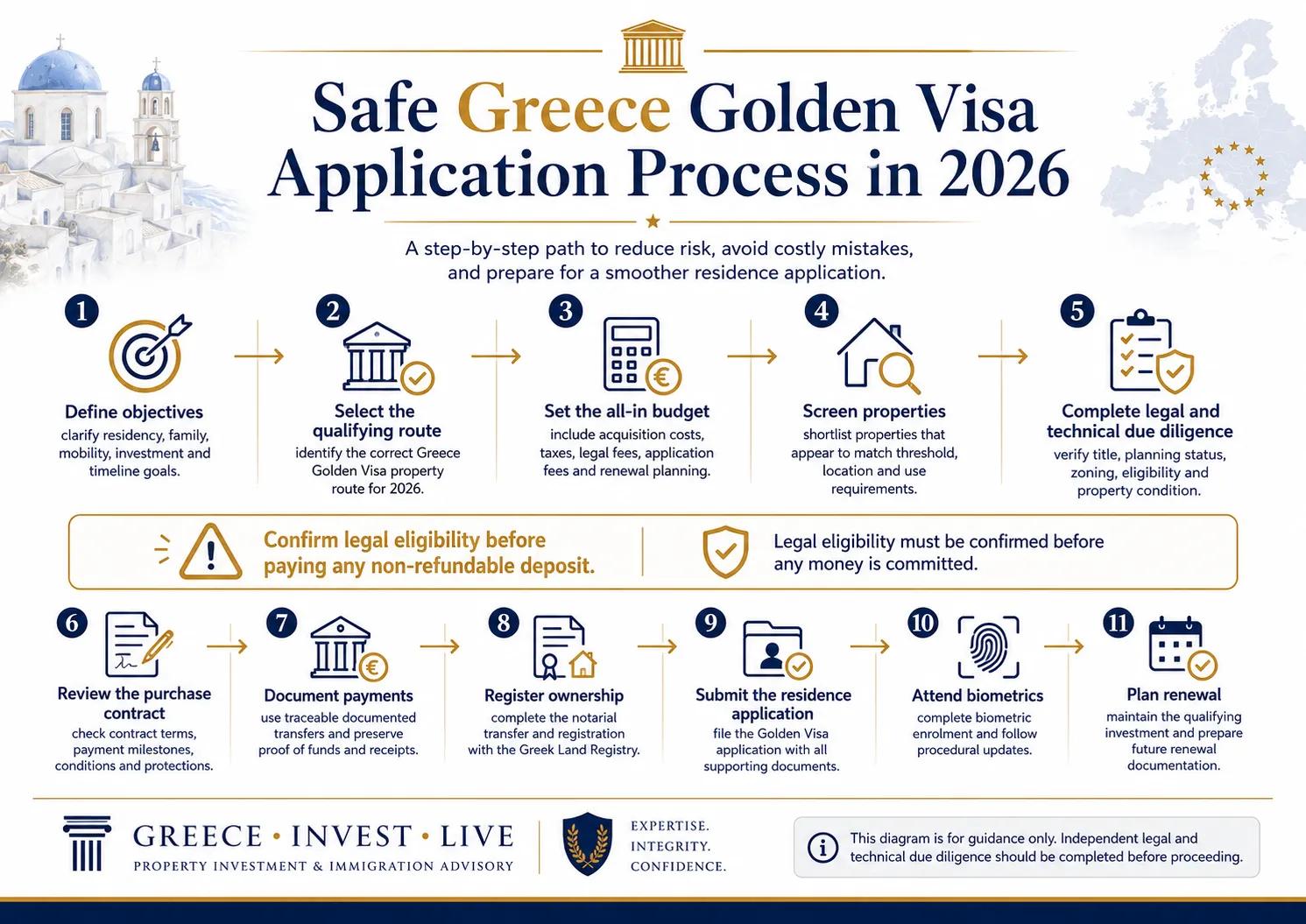
How to Reduce Greece Golden Visa Risks in 2026
The process is safer when each stage is completed in the correct order.
A structured approach may include:
Defining the investor’s immigration and financial goals
Selecting the appropriate investment route
Establishing the total budget
Screening properties for preliminary eligibility
Appointing independent legal and technical advisers
Reviewing title, planning, and building records
Confirming the applicable investment threshold
Approving the reservation and purchase terms
Verifying the payment structure
Registering ownership
Collecting proof of the investment
Preparing the residence applications
Attending biometrics
Monitoring renewal obligations
The property purchase and immigration application should be treated as one integrated project. Every contract, bank record, registration document, and technical certificate should support the same qualifying investment.
Professional Assistance for Greece Golden Visa Investors
Professional coordination can reduce the risk of incomplete documentation, unsuitable property selection, incorrect budgeting, and contractual weaknesses.
A qualified advisory team may assist with:
Initial eligibility review
Investment-route comparison
Property screening
Legal title investigation
Engineering inspections
Tax-number registration
Power-of-attorney preparation
Contract review
Payment documentation
Property registration
Investor and family applications
Biometric arrangements
Permit renewal
Long-term investment planning
Before reserving a property, applicants can review the current requirements and explore the Greece Golden Visa program.
Conclusion
The most damaging Golden Visa errors are usually preventable.
Outdated information, insufficient due diligence, rushed deposits, unrealistic budgets, and incomplete legal planning can affect both the property transaction and the residence application.
Investors who confirm eligibility first, appoint independent professionals, retain complete payment records, and plan for renewal are better equipped to protect their residence strategy and investment capital.
For applicants comparing Greece with other global residency and citizenship routes, Level Immigration provides professional guidance across a broad range of investment-migration programs.