

AADE Rental Statement for Foreign Landlords in Greece: Filing Guide
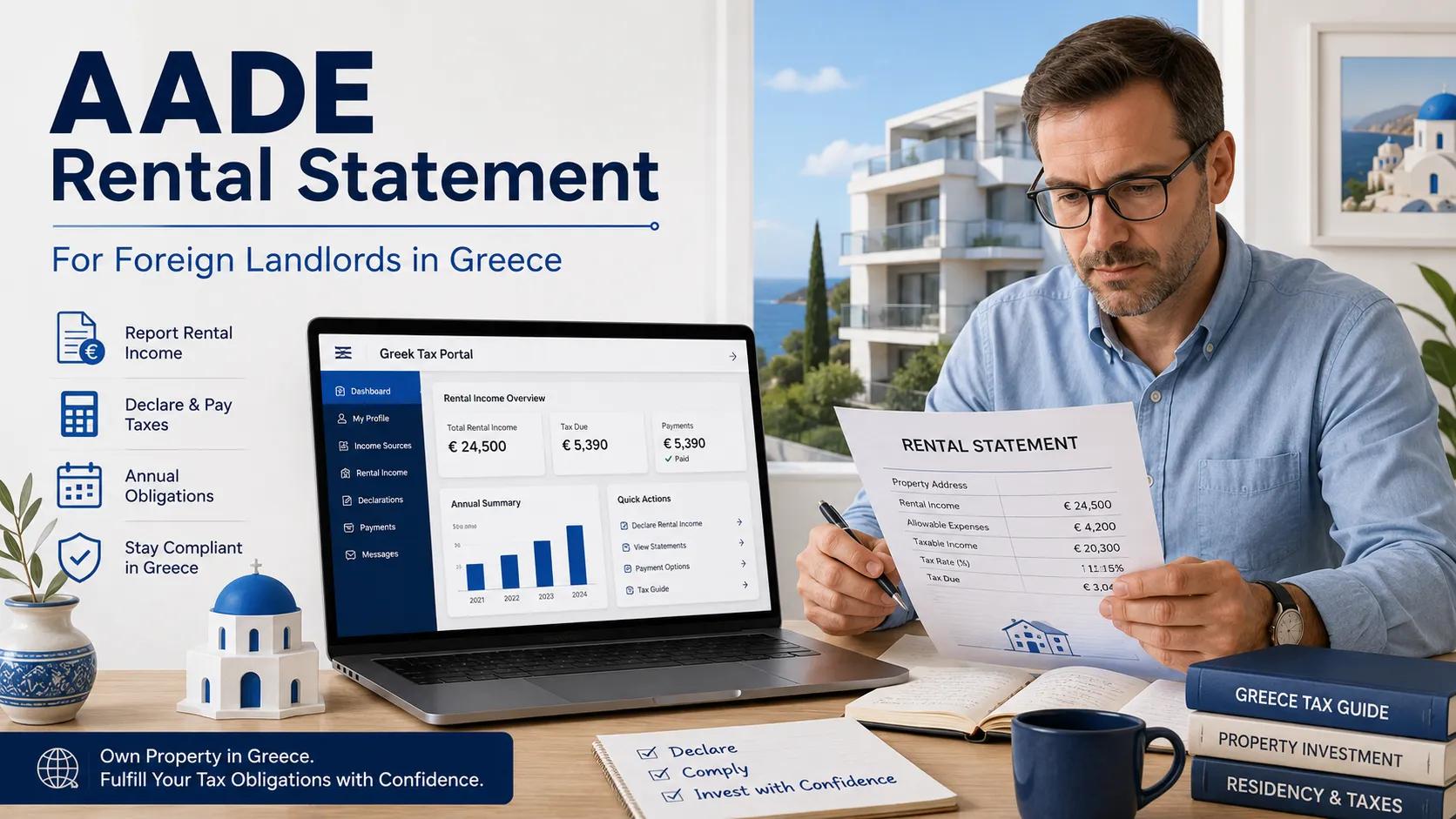
An AADE rental statement for a foreign landlord records a Greek property lease electronically with the Independent Authority for Public Revenue. Foreign owners generally follow the same electronic lease-registration process as Greek landlords, even when they live permanently outside Greece.
Registering the lease is separate from declaring the rental income in the landlord’s annual Greek tax return. Both obligations should be handled correctly to ensure that the property, tenant, rent and taxable income are consistent across the landlord’s AADE records.
What Is an AADE Property Lease Information Statement?
The Property Lease Information Statement is the electronic record of a rental agreement submitted through myAADE using Taxisnet credentials.
It records the main terms of the tenancy, including:
The landlord and tenant
The rented property
The beginning and end of the lease
The agreed monthly rent
The property identification information
Relevant electricity and energy certificate details
The Greek government’s Manage Real Estate Rentals service allows landlords to submit and manage rental information declarations for properties in Greece. The filing includes details such as the landlord’s and tenant’s AFM, lease duration, monthly rent, ATAK, electricity supply number and Energy Performance Certificate information.
The electronic statement does not replace the private rental contract. Instead, it reports the contract’s essential information to the Greek tax administration.
Must Every Greek Lease Be Registered With AADE?
A conventional long-term lease of property in Greece generally needs to be declared electronically, whether the owner is a Greek resident or a foreign landlord.
The obligation may apply to:
Residential leases
Commercial leases
New rental agreements
Renewals involving changed terms
Rent modifications
Early termination or other relevant changes
Special cases, such as certain inherited properties or arrangements that cannot be completed electronically, may require submission through the competent Greek Tax Office.
Foreign landlords should also distinguish a conventional lease from a short-term accommodation arrangement. Properties rented through short-term accommodation platforms may be subject to a different AADE registration and reporting procedure.
What a Foreign Landlord Needs Before Filing
Before declaring a rental agreement in Greece, the foreign property owner normally needs an active Greek Tax Identification Number, known as an AFM.
The owner will also need access to AADE’s digital services through Taxisnet or myAADE credentials. According to AADE’s guidance for non-residents, a foreign taxpayer, tax representative or properly authorized third party can request the issuance of an AFM and Authentication Key electronically.
The official AADE procedure for non-resident registration explains the requirements for obtaining an AFM, receiving access credentials and appointing a tax representative in Greece. Supporting documents may include identification, authorization documents and the representative’s acceptance of the appointment.
Before starting the rental declaration, landlords should collect:
Landlord’s AFM
Tenant’s AFM
Property Identification Number, or ATAK
Lease preparation date
Lease starting and ending dates
Agreed monthly rent
Electricity supply number
Energy Performance Certificate details, where required
Ownership percentages where there are multiple landlords
The information should match the property details already registered in the owner’s E9 property declaration.
How an AADE Rental Statement for a Foreign Landlord Is Filed
The declaration is submitted through the property rental section of myAADE.
1. Access the rental application
The landlord signs in using personal Taxisnet credentials. Where the filing is managed professionally, an authorized accountant or representative may complete the relevant electronic work under the appropriate authorization.
2. Select a new rental declaration
The filer creates a new Property Lease Information Statement and selects the appropriate type of rental arrangement.
3. Enter the landlord information
The statement must identify the property owner. Where a property has several co-owners, the ownership information and percentages should be reviewed carefully.
4. Add the tenant’s details
The tenant’s AFM is normally required so that the agreement can be associated with the tenant’s AADE account.
A typing error in the tenant’s AFM can connect the lease to the wrong taxpayer or prevent the tenant from viewing and accepting the declaration.
5. Identify the property
The landlord enters the ATAK corresponding to the rented property. This number connects the rental statement to the property appearing in the landlord’s E9 declaration.
The address, floor, size and property type should be consistent with the information already held by AADE.
6. Record the lease terms
The declaration should include:
Agreement date
Lease duration
Starting date
Ending date
Total monthly rent
Use of the property
The amount reported should reflect the actual contractual rent. Deposits and other payments should not be confused with the monthly rent.
7. Add electricity and energy information
The electricity supply number may be required. Where the property is subject to Energy Performance Certificate requirements, the certificate information must also be entered.
8. Review and submit
Before submitting, the landlord or accountant should check the tenant’s AFM, ATAK, dates, rent and ownership information.
Once the statement is submitted, the proof of submission should be saved with the lease contract and other property records.
What Is the Filing Deadline?
AADE states that the rental information statement must be submitted by the end of the month following the beginning of the rental agreement.
For example, if a lease begins on 10 September, the statement would generally need to be submitted by 31 October.
The same general deadline applies when the lease is modified. A change in rent, duration or another reportable term should therefore be updated by the end of the following month.
Landlords should not wait until the annual income tax filing period to register the lease. The electronic lease statement and the annual rental income declaration are separate procedures.

Can a Foreign Landlord File Through an Accountant?
A foreign landlord can generally work with a Greek accountant or authorized representative to manage the filing.
This is particularly useful when the owner:
Does not speak Greek
Lives outside Greece
Owns several rental properties
Has multiple co-owners
Needs to correct an E9 or ATAK issue
Must coordinate Greek and overseas tax reporting
The owner remains responsible for providing accurate lease terms and supporting documents. The accountant should receive the signed contract, property information, tenant’s AFM and any valid authorization required for electronic representation.
How Are Amendments and Terminations Recorded?
When the rent, lease duration or another declared term changes, the landlord should update the rental statement through the AADE application.
An amended filing should refer to the correct property and tenancy. It should not accidentally create a second active lease for the same agreement.
When a tenancy ends early, the landlord should ensure that the electronic record is updated to reflect the termination. Keeping an outdated lease active in AADE may create inconsistencies for the landlord and tenant.
After every amendment or termination, the new proof of submission should be downloaded and retained.
Rental Statements and the Annual Greek Tax Return
Registering the rental contract does not complete the landlord’s annual tax obligations.
AADE’s long-term property leasing guidance explains that property owners must declare the lease details and subsequently report their rental income through Form E2, submitted with the annual Form E1 income tax return.
Foreign landlords should reconcile:
Rental statements filed during the year
Rent actually received
Ownership percentages
Periods when the property was vacant
Form E2 rental income
The final income transferred to Form E1
Inconsistent figures can lead to questions, corrections or amended tax filings.
Common Filing Mistakes to Avoid
Common problems include entering the wrong tenant AFM, selecting an incorrect ATAK, reporting the deposit as monthly rent or using dates that do not match the signed agreement.
Other mistakes include failing to update a rent increase, leaving a terminated lease active and assuming that the electronic rental statement automatically declares the annual income.
Foreign owners should review the completed filing even when an accountant handles the submission.
Frequently Asked Questions
Must every Greek lease be registered with AADE?
Conventional property leases generally need to be declared electronically. Certain exceptional cases may require a different procedure through the competent Tax Office.
Can a foreign landlord file through an accountant?
Yes. A foreign owner may authorize a Greek accountant or representative to manage the filing, provided the required registration and authorization arrangements are in place.
What information is required from the tenant?
The tenant’s AFM is normally required, together with the lease dates, monthly rent and the use of the property. The AFM must be checked carefully before submission.
How is an amended or terminated lease recorded?
The landlord should access the original tenancy record and use the appropriate amendment or termination function. The updated proof of submission should then be saved.
Is the AADE rental statement the same as declaring rental income?
No. The rental statement registers the lease terms. Rental income is subsequently reported in Form E2 as part of the landlord’s annual Greek income tax return.