

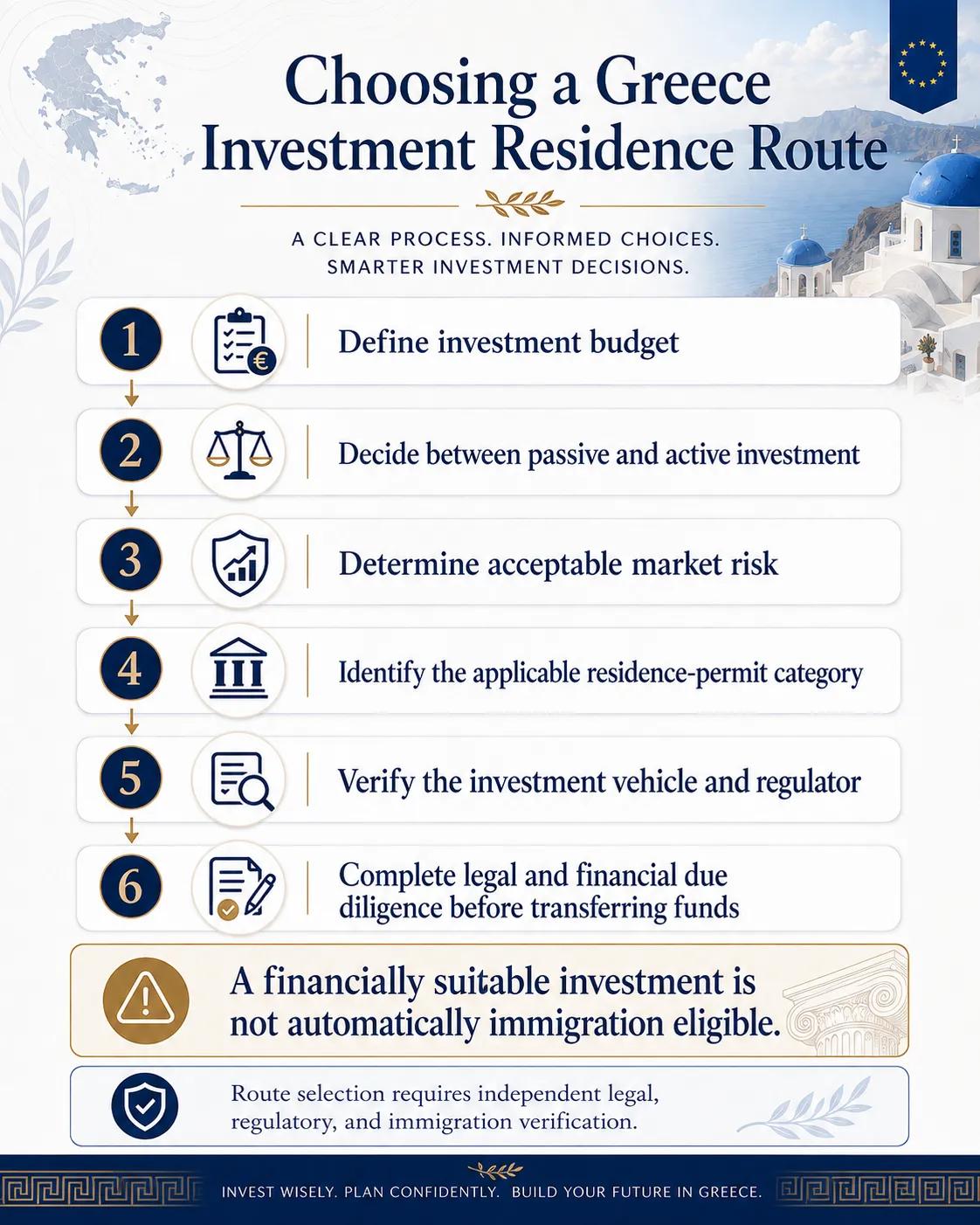
Beyond Real Estate: Alternative Greece Visa Investments 2025
Alternative Greece visa investments in 2025 give international investors several ways to pursue Greek residence without purchasing a residential property directly. While real estate remains the best-known route associated with the golden visa in Greece, Greek immigration law also provides financial investment and business-based residence categories involving funds, bonds, company capital, bank deposits and startups.
This distinction matters because Greece does not operate a single investment product with one universal minimum. The legal structure, minimum capital, documentation and investment-maintenance requirements depend on the specific investor residence category selected.
Under Greece's Migration Code, financial investments are regulated separately under Article 99 as residence permit type B.4, while property investment falls under the separate B.5 category. The legislation provides several qualifying financial routes with thresholds ranging from €350,000 to €800,000, alongside certain €500,000 options.
What Alternative Greece Visa Investments Are Available in 2025?
Investors looking beyond direct property acquisition can consider several routes under the Greek Migration Code.
The principal options include:
Investment route | Indicative minimum |
|---|---|
Qualifying mutual fund | €350,000 |
Qualifying Alternative Investment Fund | €350,000 |
Capital contribution to a qualifying Greek company | €500,000 |
Venture capital company or qualifying venture capital fund | €500,000 |
Greek government bonds | €500,000 |
Qualifying fixed-term bank deposit | €500,000 |
Capital contribution to qualifying REIC structure | €500,000 |
Listed Greek shares and qualifying bonds portfolio | €800,000 |
Qualifying startup investment | €250,000 |

€500,000 Capital Investment in Greek Companies
Article 99 also permits a minimum €500,000 capital contribution to a company with a registered office or establishment in Greece, subject to the statutory exclusions and conditions.
The investment may involve acquiring shares through a capital increase or bonds issued through a qualifying bond loan where the securities are admitted to trading through eligible Greek markets.
This option can appeal to investors who want their residence strategy to be connected with productive business activity rather than a passive property purchase.
However, investing €500,000 into any privately selected Greek business does not automatically qualify. The transaction, securities and financial intermediary must satisfy the legal framework.
Investors comparing this route with the conventional Greece Golden Visa program should therefore examine not only the required capital but also the investment structure and documentary burden.
€500,000 Greek Government Bonds
Investors can also qualify through the purchase of Greek government bonds with a minimum acquisition value of €500,000.
Under Article 99, the bonds must have a remaining maturity of at least three years at the time they are purchased. The acquisition must also be made through a credit institution established in Greece that acts as custodian.
Government bonds offer a very different investment profile from purchasing an apartment or investing in a private company. There are no tenants, renovations or property-management responsibilities, but investors still face financial-market considerations including interest-rate risk, bond pricing and liquidity.
Residence eligibility should therefore be analysed separately from investment performance.
€500,000 Fixed-Term Bank Deposit
Another financial route involves maintaining a fixed-term deposit of at least €500,000 with a Greek credit institution.
The Migration Code requires a minimum term of one year together with a standing renewal instruction. The institution is also responsible for providing documentation confirming the establishment and maintenance of the qualifying investment.
This structure can be comparatively straightforward from an asset-management perspective, but it still requires substantial capital to remain committed to the qualifying structure.
Investors should compare deposit rates, bank risk, inflation, currency considerations and the opportunity cost of keeping €500,000 in a deposit rather than another asset class.

Greece's €250,000 Startup Investment Route
A particularly important development for 2025 was the introduction of a separate investor residence route for qualifying Greek startups.
Law 5162/2024 added Article 100A to the Migration Code and created residence permit type B.6. It provides for an investment of at least €250,000 in the capital of a company registered with Greece's National Startup Registry.
The law includes additional conditions. Among other requirements:
the investor's acquired participation or voting rights cannot exceed 33%;
the startup must create at least two new jobs within the first year after the investment; and
the required employment level must be maintained for at least five years following the investment.
This makes the startup route significantly different from a passive bank deposit or government bond investment.
It links residence eligibility to a business that must satisfy continuing operational and employment conditions. Investors therefore need to evaluate the startup itself as well as the immigration structure.
A €250,000 minimum may look attractive on paper, but startup investing carries substantial commercial risk. Residence eligibility does not mean the underlying company is financially secure or that an investment will produce a return.
Financial Investment vs Real Estate Golden Visa
Neither route is universally better.
The appropriate strategy depends on what the investor wants the capital to accomplish.
Direct real estate may appeal to someone seeking a tangible asset, personal accommodation or long-term exposure to the Greek property market. Financial investments may appeal to someone who prefers securities, professional fund management, business participation or reduced responsibility for managing physical property.
Some of the main differences include:
Factor | Financial investment | Direct property |
Physical asset management | Usually limited | Often required |
Investment diversification | Possible depending on route | Usually concentrated |
Market liquidity | Varies by instrument | Generally lower |
Property maintenance | None for most routes | Required |
Investment risk | Market, credit or business risk | Property and market risk |
Minimum investment | Depends on route | Depends on property category and location |
Compliance documentation | Financial/custody focused | Property/legal focused |
The cheapest route should not automatically be treated as the best route. A €250,000 startup investment, for example, may involve substantially more commercial uncertainty than a fixed-term deposit, while an €800,000 securities portfolio requires substantially more capital.
Maintaining the Qualifying Investment
Obtaining the residence permit is not the end of the compliance process.
For financial investment routes, Greek authorities can require evidence demonstrating that the qualifying investment continues to be maintained. The investment structure and supporting accounts therefore need to remain compliant during the relevant residence period.
A 2025 ministerial decision on investor residence procedures confirms that the Directorate of Foreign Direct Investments participates in reviewing and monitoring qualifying investments and can require supporting documentation. The official investor residence procedure should therefore be reviewed alongside the investment-specific legislation.
Selling, redeeming, transferring or restructuring a qualifying investment without first understanding the residence consequences can create compliance problems.

Conclusion
Greece's investor residence framework is broader than direct property acquisition. In 2025, investors could consider qualifying mutual funds and AIFs from €350,000, several company, bond and deposit structures from €500,000, an €800,000 listed-securities route and the newer €250,000 qualifying startup investment route.
Each option comes with different investment risks, documentation standards and maintenance obligations. The correct comparison is therefore not simply “property or no property,” but which qualifying structure best matches the investor's capital, risk tolerance and long-term objectives.
For investors comparing Greece with wider international residency opportunities, Level Immigration provides guidance on residency and investment migration programs across multiple jurisdictions.