

Greece Tourism Investment Guide 2025: Where Investors Are Finding Opportunity
Tourism investment in Greece continued to attract international attention in 2025 as the country combined strong visitor demand with an increasingly diverse hospitality and real estate market.
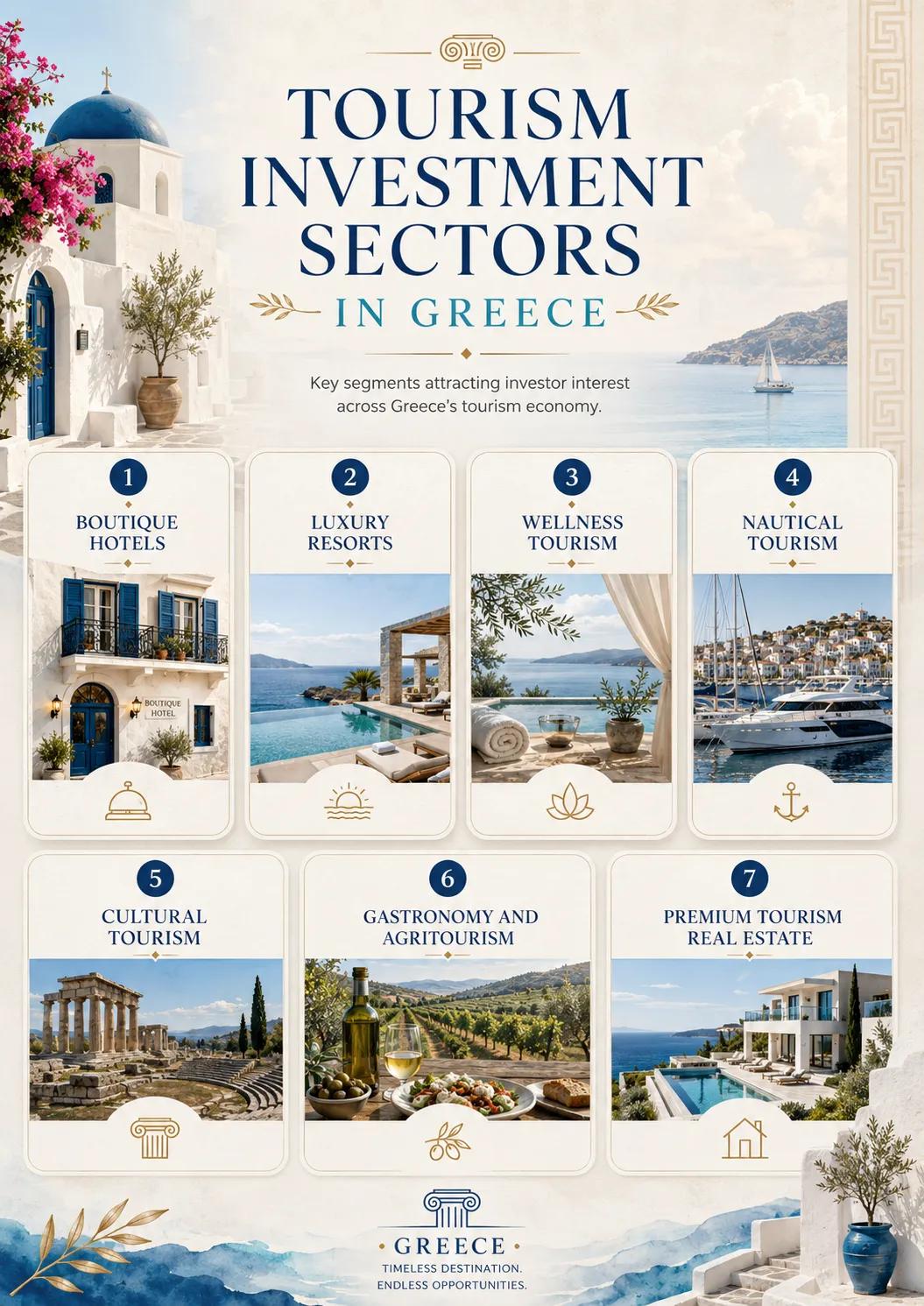
Greece is no longer simply a seasonal destination built around beaches and summer holidays. Athens has strengthened its position as a city-break market, Crete supports multiple tourism segments, established islands continue to attract premium travellers, and specialised sectors such as wellness, nautical tourism, gastronomy, and cultural travel are creating new opportunities.
Final figures from the Bank of Greece showed that travel receipts increased by 9.4% in 2025, while inbound traveller flows rose by 6.4%.
For investors, these figures provide strong market context. But successful tourism investment still depends on choosing the right location, asset, operating model, and customer segment.
What Is Driving Tourism Investment in Greece?
Greece has several structural advantages as an international tourism market.
Its appeal combines:
Mediterranean climate
Extensive coastline
Globally recognised islands
Historic cities
Archaeological landmarks
Food and wine culture
International airports
Ferry and cruise infrastructure
Established hospitality expertise
Growing luxury travel demand
The country's tourism strategy is also becoming broader.
Rather than relying entirely on high-volume summer tourism, Greece is increasingly focusing on higher-value visitors, specialised experiences, improved hospitality standards, and longer tourism seasons.
Enterprise Greece identifies several areas with investment potential, including hotel upgrades, integrated resorts, specialised tourism, city breaks, marinas, wellness, and other higher-quality tourism products.
This creates opportunities for investors with very different budgets and strategies.

Tourism Investment in Greece Beyond Hotels
Traditional hotels remain central to the industry, but they are only one part of the investment landscape.
Travellers increasingly look for experiences that combine accommodation with activities, wellness, food, nature, or culture.
Boutique Hospitality
Small and distinctive hotels can compete through design, location, local character, and service rather than scale.
Historic neighbourhoods, island villages, and traditional properties can be suitable for boutique hospitality concepts where planning and building conditions allow.
Luxury Resorts
Premium travel remains an important part of Greece's tourism offer.
Luxury resort investment can combine accommodation with:
Private beaches
Wellness facilities
Restaurants
Sports facilities
Villas
Private pools
Yacht access
Personalised guest services
The capital required can be considerably higher, but the strategy targets visitors with greater spending capacity.
Wellness Tourism
Wellness tourism offers investors an opportunity to move beyond purely seasonal leisure travel.
Concepts may include:
Spa hotels
Yoga retreats
Fitness resorts
Thermal tourism
Holistic wellness centres
Luxury coastal retreats
Greece's climate and natural environment can support projects aimed at travellers seeking health, relaxation, and lifestyle experiences.

Cultural Tourism
Greece's history creates another investment advantage.
Properties near archaeological destinations, historic centres, museums, and traditional settlements may support cultural tourism throughout a wider part of the year.
Heritage buildings may also offer opportunities for distinctive accommodation, subject to restoration, planning, and conservation requirements.
Can Tourism Property Be Connected to the Greece Golden Visa?
Some foreign investors want two outcomes from a Greek property purchase: an investment asset and residence rights.
These objectives can sometimes overlap, but they should never be assumed to be identical.
A commercially successful tourism property does not automatically qualify for the Golden Visa.
Similarly, a property that satisfies residency requirements is not automatically a strong tourism investment.
Investors considering residence should review the current Greece Golden Visa program requirements before committing to a transaction.
Golden Visa eligibility can depend on:
Investment route
Property location
Required investment amount
Property characteristics
Legal use
Structure of the transaction
Current immigration regulations
The Greek Ministry of Migration and Asylum should also be consulted for official residence-permit information.
The safest approach is to analyse immigration eligibility and commercial investment potential separately.
What Types of Tourism Property Can Investors Consider?
Tourism real estate covers a broad range of assets.
Depending on strategy and budget, investors may examine:
Operating hotels
Hotels requiring modernisation
Villas
Resort properties
Urban buildings
Commercial-to-hospitality conversion opportunities
Boutique accommodation
Properties requiring restoration
Assets close to tourism infrastructure
Foreign buyers considering residency-related real estate can also review available Greece Golden Visa properties while conducting independent legal and financial due diligence.
The property's future business model should be considered before purchasing, not after.
How to Evaluate a Tourism Property Investment
A structured review can help investors separate genuinely attractive opportunities from properties that simply look appealing in photographs.
Understanding the Real Cost of Tourism Investment
Purchase price is only one component of the total investment.
A realistic budget may also need to account for:
Taxes
Lawyers
Notaries
Technical inspections
Renovation
Furniture
Hospitality equipment
Insurance
Staff
Utilities
Maintenance
Marketing
Property management
Booking commissions
Financing costs
Licensing
Underestimating operating expenses is one of the easiest ways to make an attractive-looking tourism investment perform poorly.
Revenue assumptions should also reflect realistic occupancy across the entire year.
August is useful for forecasting peak demand. It is considerably less useful as a twelve-month business model.
Conclusion
Greece's tourism sector provided a broad investment landscape in 2025, extending far beyond conventional beachfront hotels.
Strong visitor demand supports established destinations, while changing travel preferences are opening opportunities in boutique hospitality, wellness, cultural tourism, gastronomy, nautical tourism, and tourism-focused real estate.
However, market growth does not make every project attractive.
Successful investors need to match the right property with the right destination, traveller profile, operating model, and financial assumptions.
Thorough due diligence remains essential, particularly when renovation, hospitality licensing, planning restrictions, or Golden Visa eligibility are involved.
For investors researching Greek tourism real estate more broadly, Top House Greece provides additional insight into property opportunities across the country.