

Greece vs Dubai Golden Visa 2026: Comparing EU Residency and UAE Long-Term Residence
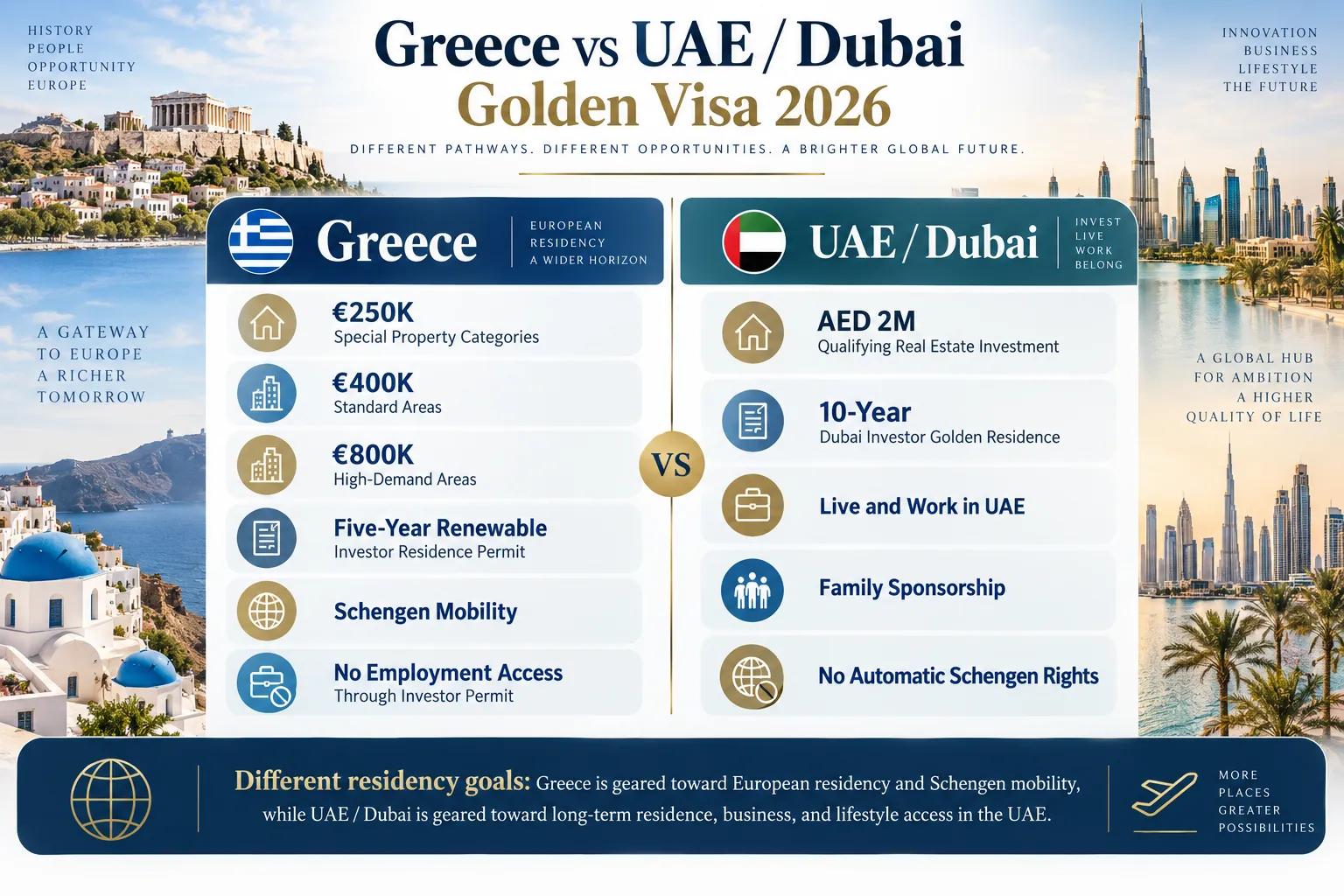
Greece Golden Visa vs UAE / Dubai Golden Visa comparisons often begin with investment amounts, but the bigger difference is what each residence programme is designed to achieve. Greece gives qualifying investors a residence base within the European Union and Schengen Area. Dubai offers long-term residence in the UAE, one of the world's leading international business centres.
Both can appeal to property investors, internationally mobile families, entrepreneurs, and people looking for a second residence. However, choosing between them requires more than asking which property threshold is lower.
Investors should consider where they want to spend time, where they need mobility, whether they intend to work locally, how they want to invest their capital, and what role the residence permit will play in their long-term plans.
Greece vs Dubai Golden Visa: Main Differences
Feature | Greece Golden Visa | Dubai / UAE Golden Visa |
|---|---|---|
Main objective | European investor residence | Long-term UAE residence |
Property route | €250K, €400K or €800K depending on category and location | AED 2M qualifying real estate |
Residence validity | 5 years | 10 years for qualifying Dubai investors |
Renewal | Renewable while conditions remain satisfied | Renewable subject to continued eligibility |
Schengen mobility | Yes, subject to applicable rules | No automatic Schengen residence rights |
Employment | Investor permit does not itself grant employment rights | Golden Residency supports living and working in the UAE |
Family inclusion | Available for eligible family members | Available for eligible family members |
Geographic advantage | EU and Schengen base | UAE and Gulf base |
The programmes therefore solve different problems.
Greece is primarily attractive to investors looking toward Europe. Dubai is stronger for investors whose personal or commercial interests are centred on the UAE and Gulf region.
Why Investors Choose the Greece Golden Visa
The Greece Golden Visa allows qualifying non-EU nationals to obtain a renewable residence permit through approved investments, with real estate remaining one of the most established routes.
The property investment structure now operates across several thresholds.
An €800,000 minimum generally applies to qualifying property purchases in specified high-demand areas such as Attica, Thessaloniki, Mykonos, Santorini, and Greek islands with populations exceeding 3,100.
A €400,000 threshold applies to standard qualifying investments in many other areas.
A separate €250,000 route remains available for certain special property categories, including qualifying conversions from commercial to residential use and investments involving eligible listed buildings subject to restoration requirements.
These distinctions make it important to examine the specific Greece Golden Visa program rather than assuming that any €250,000 property will qualify.
The residence permit is generally issued for five years and can be renewed in additional five-year periods when the underlying investment and programme requirements remain satisfied.
One of the programme's most important characteristics for internationally mobile investors is that maintaining the residence permit does not generally require living full-time in Greece.
What Makes the Dubai Golden Visa Different?
The Dubai Golden Visa falls within the UAE's wider Golden Residency system.
For qualifying real estate investors in Dubai, the current investor route generally requires ownership of property or properties with a combined value of at least AED 2 million, subject to the applicable documentation and eligibility requirements.
Dubai's immigration authority provides qualifying investors with a 10-year Golden Residence, which can be extended where the eligibility requirements continue to be met.
The programme is therefore particularly relevant for investors who want to make the UAE a long-term personal or business base.
Unlike Greece's investor residence permit, the broader UAE Golden Residency framework is designed to support eligible individuals who intend to live, work, study, invest, or conduct professional activities in the country.
This difference can be more important than the permit duration itself.
European Mobility or Gulf Connectivity?
For many investors, geography provides the clearest answer.
Greece is a member of the Schengen Area. Holding a valid Greek residence permit therefore creates a European residence base and facilitates short-term travel throughout other Schengen states under the applicable rules.
This can be particularly valuable for people who regularly travel between European financial centres, maintain business relationships across the continent, or want easier access to European destinations for their families.
Dubai offers a different kind of connectivity.
Its location gives investors easy access to markets across the Gulf, Middle East, Asia, Africa, and Europe. Dubai International Airport is also one of the world's major aviation hubs, making the emirate a practical base for people whose work or investments span several regions.
The choice is therefore less about which location has better flights and more about which region needs to become part of the investor's legal residence strategy.
Greece vs Dubai Property Investment
Real estate plays an important role in both programmes, but the investment logic differs.
Investing in Greec

Greek property can simultaneously provide a physical asset and eligibility for European residence when the investment satisfies Golden Visa rules.
Depending on the route, an investor might consider:
Special qualifying properties from €250,000
Standard properties from €400,000
Properties subject to the €800,000 threshold in designated high-demand markets
The investment should be assessed on more than purchase price.
Property type, qualifying status, location, rental prospects, transaction costs, future resale potential, and applicable restrictions all matter.
Investors searching specifically for eligible opportunities can review Greece Golden Visa properties rather than treating ordinary Greek real estate listings as automatically suitable for residency purposes.
Investing in Dubai
Dubai uses a higher headline threshold for the real estate Golden Visa route, with qualifying investment generally beginning at AED 2 million.
The attraction is different.
An investor may combine ownership of Dubai real estate with long-term UAE residence and proximity to one of the region's largest business ecosystems.
For entrepreneurs who already operate companies or maintain significant business relationships in the Gulf, that can make the residence component especially valuable.
Can You Work With Either Golden Visa?
This is one of the areas where Greece and the UAE differ significantly.
The Greek investor residence permit does not itself give the holder access to employment in Greece.
That distinction matters for applicants who intend to take a conventional job or participate in employment activities that require separate authorisation.
Dubai's Golden Residency framework is more suitable for applicants who expect to remain economically active in the UAE. Eligible holders can live and work in the country under the wider Golden Residency framework without depending on the traditional employer-sponsored residence model.
For entrepreneurs and internationally active professionals, this can make Dubai particularly attractive.

Greece or Dubai Golden Visa: Final Decision
The choice ultimately depends on what the investor wants residence to accomplish.
Choose Greece when Europe is the priority. The Greece Golden Visa offers qualifying investors a renewable residence permit in an EU and Schengen country, with property investment routes available across different thresholds.
Choose Dubai when the UAE is the priority. The Dubai Golden Visa offers qualifying investors long-term residence in an internationally connected business environment with broader possibilities for professional and commercial activity.
Neither programme is automatically better.
The strongest choice is the one aligned with the investor's actual geographic, financial, family, and business objectives.
Before committing capital, investors should compare qualifying investment requirements, property eligibility, taxes, government fees, residence rights, family rules, renewal obligations, and the long-term role the permit will play in their international plans.
For investors comparing Greece, Dubai, and other global residence programmes, Level Immigration can provide guidance on residency and citizenship options across multiple jurisdictions.