

Greece vs Hungary Investor Residency 2026: Which Route Fits Your Strategy?
The Greece vs Hungary Golden Visa comparison can look surprisingly close at first glance. Both countries are in the Schengen Area, both offer investment-linked residence options for qualifying non-EU nationals, and both currently have routes associated with a €250,000 investment.
But that matching number hides two very different approaches.
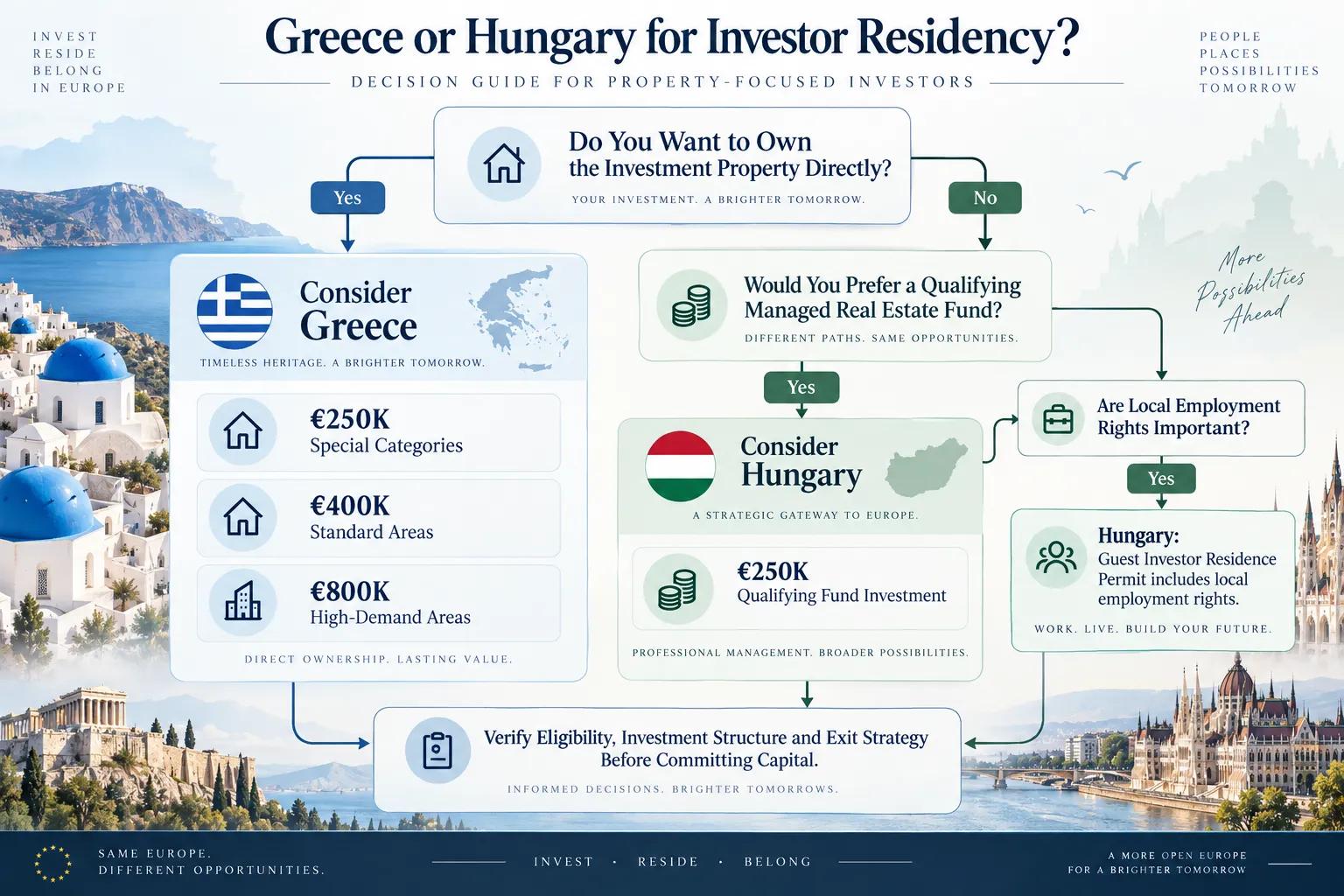
Greece gives investors the opportunity to connect residency with direct ownership of qualifying real estate. Hungary's Guest Investor Programme currently uses a qualifying real estate investment fund for its €250,000 route.
For investors choosing between them in 2026, the real question is therefore not simply, "Which one is cheaper?" It is whether direct property ownership, permit duration, employment rights, investment control, or simplicity matters most.
Greece vs Hungary Golden Visa: Main Differences
Comparison | Greece | Hungary |
|---|---|---|
Investor residence route | Golden Visa | Guest Investor Residence Permit |
Lowest current investment level | €250,000 for specific qualifying property categories | €250,000 qualifying real estate fund shares |
Other major investment levels | €400,000 and €800,000 depending on property/location | €1 million qualifying donation |
Direct qualifying property purchase | Yes | Not among the currently listed Guest Investor investment routes |
Residence permit | 5 years | Up to 10 years |
Renewal/extension | Available if applicable requirements remain satisfied | Extension possible for up to another 10 years |
Employment through investor permit | No | Yes |
Schengen country | Yes | Yes |
Main investment character | Direct real estate | Investment fund |
The programmes therefore start from different investment philosophies.
Greece may suit someone who wants to know exactly which building, apartment or other qualifying property their capital is buying. Hungary may appeal to investors who would rather obtain real-estate exposure through a professionally managed investment structure.
Why Greece Appeals to Direct Property Buyers
Property remains at the centre of the Greek investor residency proposition.
The Greek framework currently operates with different thresholds depending on the location and nature of the property. Standard qualifying acquisitions may require €400,000 or €800,000, while certain special property categories continue to qualify from €250,000.
One €250,000 category covers qualifying properties converted from commercial or another permitted use to residential use. The official Greek National Registry states that the investor must acquire full ownership and possession of a single qualifying property with a minimum acquisition value of €250,000, subject to the applicable conversion requirements.
This gives the golden visa in Greece a characteristic that many other European residence programmes do not offer: the immigration investment can also be an individually selected piece of real estate.

Understanding Greece's €250K, €400K and €800K Structure
It is important not to describe the Greek Golden Visa as simply a "€250,000 property programme."
That minimum applies only to particular eligible property categories.
The wider system includes €800,000 thresholds in specified higher-demand areas and €400,000 thresholds in other qualifying regions, alongside the €250,000 special routes.
Current Greek administrative guidance, for example, confirms €800,000 thresholds for relevant transactions in Attica, Thessaloniki, Mykonos, Thira and qualifying islands with populations above 3,100, with €400,000 applying to relevant investments in other areas.
The right investment level therefore depends on the specific asset and legal basis being used.
Investors considering Greece residency by investment should establish the property's qualifying category before treating its purchase price as sufficient for Golden Visa eligibility.

Residence Is Not the Same as Citizenship
Another important distinction applies to both countries.
Neither programme should be described as direct citizenship by investment.
The qualifying investment provides a route to residence, not an automatic passport.
Any future eligibility for naturalisation is governed by separate nationality rules and requirements. Investors should therefore avoid treating residence permit duration as a countdown to guaranteed citizenship.
Someone whose primary objective is obtaining a second nationality rather than European investor residence may need to compare a different category of programme entirely.
For investors comparing international residence and citizenship strategies beyond Greece and Hungary, Level Immigration provides guidance across multiple investment migration options.
One of Greece's strongest advantages is control over the qualifying investment.
A property investor can conduct due diligence on a specific asset, compare locations, examine the building's condition and legal status, assess the purchase price and plan an eventual exit.
There is still significant due diligence involved. Golden Visa eligibility does not automatically make a property a good investment, and a financially attractive property does not automatically qualify for the programme.
But the investor can evaluate the asset directly.
Hungary's fund structure creates a different relationship. The investor is relying more heavily on the qualifying investment vehicle, its management and its underlying portfolio.
That can be attractive for someone who does not want the work associated with sourcing and owning a specific property.
It can be less attractive for someone whose goal is direct control over European real estate.
Hungary Offers the Longer Residence Permit
Hungary becomes particularly competitive when permit duration is considered.
Its Guest Investor Residence Permit can be valid for up to 10 years and may be extended for another period of up to 10 years for the same purpose, provided the relevant extension requirements are satisfied.
By comparison, Greece generally issues qualifying Golden Visa residence permits for five years.
Greek official administrative guidance confirms a five-year validity period for qualifying investor residence permits.
For an investor who values administrative convenience and longer periods between residence-permit renewals, Hungary has a clear advantage.
However, the longer permit needs to be weighed against the different investment structure.
A ten-year residence permit attached to a fund investment and a five-year residence permit supported by directly owned property are not interchangeable propositions.