

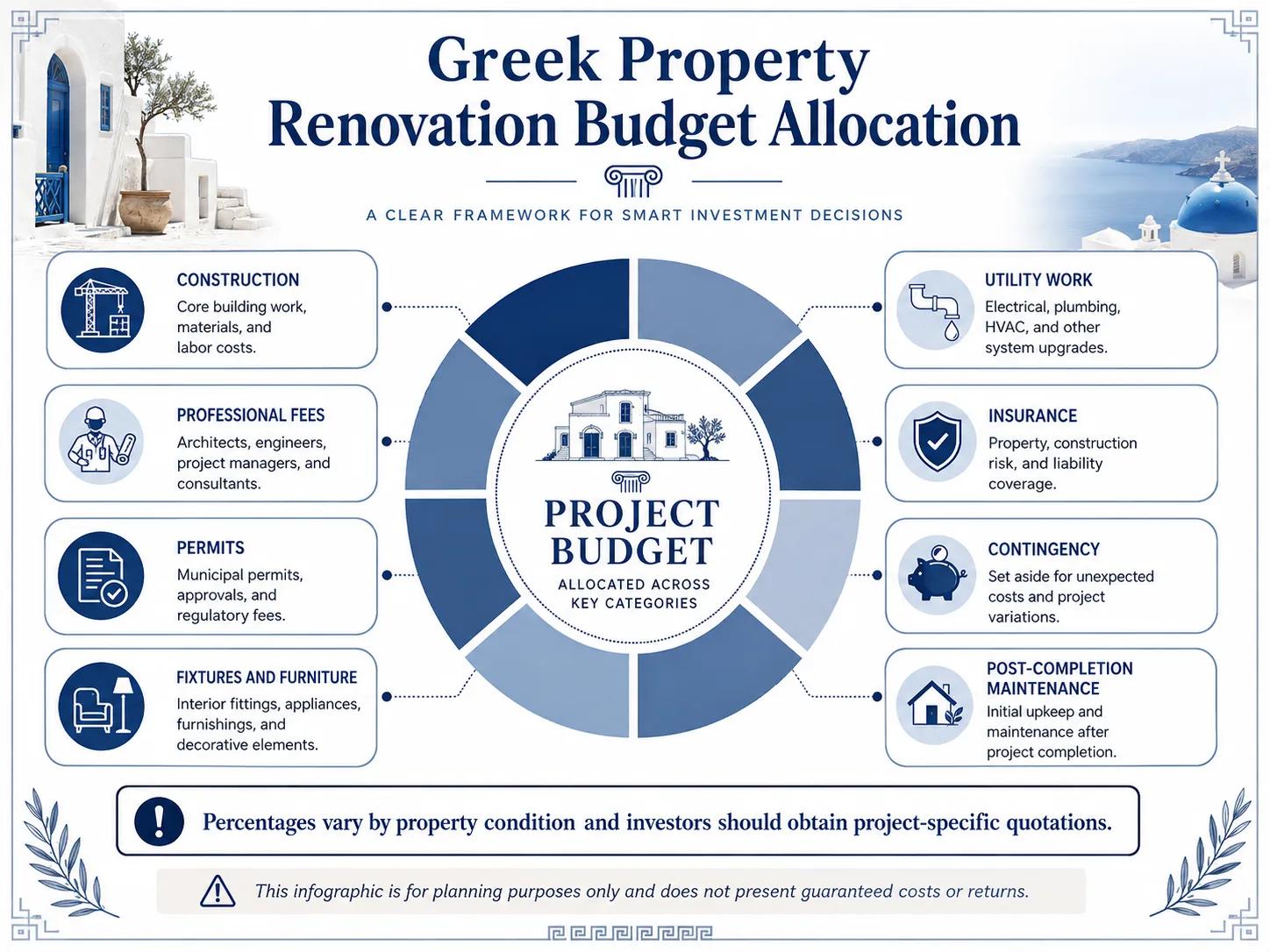
Greek Property Renovation for Investors: Due Diligence, Costs and Smart Planning
Greek property renovation can turn an ageing apartment, neglected house, or underused building into a more functional real-estate asset, but successful projects require much more than choosing finishes and hiring a contractor.
For overseas investors, the key questions start before renovation begins. Is the property's existing layout legal? What approvals will the planned work require? Are there hidden structural or utility problems? Does the budget include professional fees and unexpected repairs? And, for residency-focused investors, does the property fit the intended Golden Visa strategy?
A well-managed renovation starts with answers to these questions.
Why Greek Property Renovation Should Begin Before Purchase
The renovation process effectively begins during property selection.
Older properties can appear attractive because their purchase prices may leave room for refurbishment. However, a lower acquisition price can quickly lose its advantage if the property contains major technical or regulatory issues.
Before making a final purchase decision, investors should look beyond visible finishes and examine:
Structural condition
Moisture and waterproofing
Plumbing
Electrical installations
Heating and cooling
Roof and balcony condition
Windows and insulation
Previous alterations
Building permits
Approved floor plans
Restrictions affecting the property
An attractive apartment with an outdated kitchen may be relatively straightforward to improve. A property with unauthorised extensions, significant water damage, or structural defects presents a completely different investment profile.
The purchase price should therefore be considered together with the estimated cost of bringing the property into the required legal, technical, and functional condition.
Understand Renovation Permit Requirements in Greece
Not every improvement requires the same type of approval.
Painting, replacing furniture, and carrying out basic cosmetic upgrades are very different from altering structural components, changing a property's use, or completing extensive building works.
Greece operates the e-Άδειες electronic permitting platform under the Ministry of Environment and Energy and the Technical Chamber of Greece. Building permits and an increasing number of related planning procedures are handled electronically through this system.
Before work starts, an engineer should establish whether the project requires:
No specific construction approval
Small-scale works approval
A building permit
Architectural approval
Additional permission because of the property's location or protected status
Investors should avoid allowing contractors to begin significant alterations before this has been confirmed.
The phrase "we can sort the paperwork later" rarely belongs in a good renovation strategy.

Write a Proper Scope of Work
One of the easiest ways to create confusion during renovation is to rely on vague instructions.
"Renovate the apartment" means different things to different contractors.
A detailed scope of work should identify exactly what will be removed, repaired, replaced, installed, and finished.
For example, a kitchen specification might include:
Demolition and waste removal
Plumbing alterations
Electrical connections
Cabinetry
Worktops
Flooring
Lighting
Appliances
Painting
Ventilation
Final testing
The same level of detail should be used throughout the property.
Investors should also establish which materials are included in the contractor's quotation and which items must be purchased separately.
A detailed scope makes competing quotations easier to compare and reduces the possibility of disagreements once construction begins.
Spend on Infrastructure Before Decoration
Renovation budgets are often more effective when essential building systems are prioritised before visual improvements.
An investor may be tempted to begin with designer tiles, lighting, furniture, or kitchen finishes. However, underlying problems should come first.
Priority areas may include:
Renovate According to the Target Buyer or Tenant
A good renovation should fit the intended market rather than simply reflect the owner's personal taste.
An apartment intended for long-term family use may require storage, durable materials, efficient heating, and functional bedrooms.
A smaller city apartment may benefit more from space-efficient layouts, practical kitchens, good lighting, and low-maintenance finishes.
Investors assessing Greece Golden Visa properties for sale should also evaluate whether the property's renovation requirements are consistent with the total investment budget and intended residency strategy.
Useful questions include:
Who is likely to occupy the property?
How long is the expected holding period?
Which improvements genuinely improve usability?
Which finishes are appropriate for the property's market?
Is the renovation becoming excessive relative to the asset?
More expensive does not automatically mean more investable.
Renovation and the €250,000 Golden Visa Property Routes
Renovation has particular relevance for certain categories within Greece's Golden Visa framework.
Article 64 of Law 5100/2024 introduced special €250,000 real-estate routes, including qualifying property where the main spaces are converted to residential use and qualifying listed buildings requiring restoration or reconstruction. The Greek government's Housing Policy Portal describes these specific investment categories.
This does not mean that any old commercial building or renovation project automatically qualifies at €250,000.
Investors need to verify factors such as:
Existing property classification
Permitted change of use
Required completion conditions
Property acquisition structure
Relevant investment value
Restoration obligations
Supporting legal and technical documentation
The Ministry of Migration and Asylum also publishes official Golden Visa application and investor-residence documentation.
Investors considering renovation alongside residency should therefore coordinate their lawyer, engineer, notary, and property adviser before committing to the acquisition.
For broader program guidance, working with a knowledgeable Greece Golden Visa consultant can help investors evaluate residency requirements alongside the property transaction.

Compare Contractors Carefully
Investors should normally obtain more than one detailed quotation.
Price matters, but it should not be the only selection criterion.
A contractor should also be evaluated according to:
Relevant renovation experience
Previous projects
References
Quality of quotations
Proposed materials
Project schedule
Professional organisation
Communication
Payment terms
Ability to coordinate with engineers and architects
Very large upfront payments can increase investor exposure.
Where practical, contracts can connect payments to specific milestones, such as demolition completion, electrical and plumbing work, installation stages, and final delivery.
Control Renovation Changes
Most renovation projects involve at least some changes.
The important issue is how those changes are managed.
For every significant variation, the investor should document:
What is changing
Why the change is required
Additional cost
Effect on the project schedule
Who approved it
This prevents a project from accumulating numerous small additions that eventually create a major budget overrun.
International investors can also request:
Regular photographs
Video walkthroughs
Engineer reports
Updated budgets
Site inspection reports
Copies of invoices
Written confirmation before additional work
Remote ownership does not have to mean remote control of the project.

Final Thoughts
Successful property renovation in Greece depends on preparation more than decoration.
Investors who complete technical due diligence, verify permits, prepare detailed scopes of work, maintain realistic budgets, appoint suitable professionals, and monitor construction are better positioned to manage renovation risk.
For Golden Visa investors, property and residency planning should also be considered together rather than as separate decisions. The legal structure, investment category, physical condition of the property, and required renovation work can all influence whether a project fits the investor's wider objective.
For investors considering residency or citizenship opportunities across several countries, Level Immigration provides professional guidance on international residency and citizenship by investment programs.
Frequently Asked Questions
Is Greek property renovation suitable for foreign investors?
Foreign investors can renovate property in Greece, but they should complete legal and technical due diligence and use qualified local professionals to assess the building and planned works.
How much does property renovation cost in Greece?
There is no reliable single figure because costs depend on the property's condition, size, location, specifications, required permits, materials, and extent of technical work. Project-specific quotations are more useful than generic cost estimates.
Do renovations in Greece require a building permit?
Some works may require approvals or permits while minor cosmetic improvements may follow different requirements. An engineer should determine the applicable procedure before construction starts.
How should overseas investors monitor renovation work?
Regular photographs, video walkthroughs, cost reports, engineer inspections, milestone-based payments, and written approval of variations can make remote project supervision more manageable.