

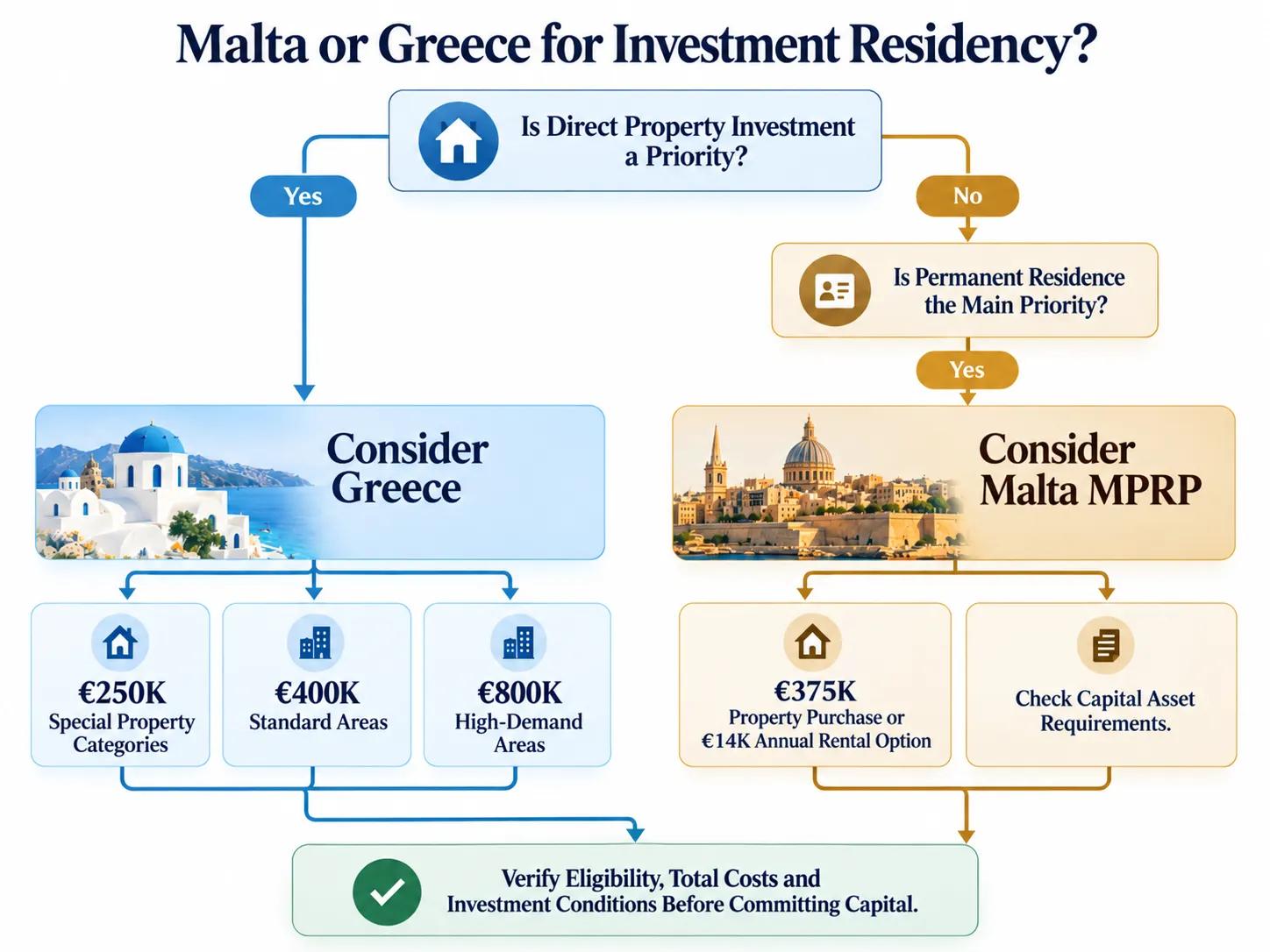
Malta or Greece Golden Visa: Comparing European Residency Options in 2026
For investors researching Malta vs Greece Golden Visa options, the first thing to understand is that these are not two identical programmes competing on price alone.
Greece offers an investor residence permit built largely around qualifying investments, particularly real estate. Malta's comparable route is the Malta Permanent Residence Programme (MPRP), which combines a property requirement with government charges, financial-asset criteria and due diligence.
Both can provide residence in a Schengen country, but they appeal to different types of applicants. Greece tends to suit investors who want their capital tied to an investment asset, while Malta can appeal to families whose main objective is obtaining permanent residence and who are comfortable with a more fee-heavy structure.
Malta vs Greece Golden Visa in 2026
Factor | Greece Golden Visa | Malta MPRP |
|---|---|---|
Residence status | Investor residence permit | Permanent residence |
Validity | 5 years, renewable | Permanent, subject to continued compliance |
Property purchase threshold | €250K, €400K or €800K depending on route | €375K minimum |
Rental alternative | Not under the standard property Golden Visa route | €14K minimum annual rent |
Administration fee | Application and permit fees apply | €60K |
Government contribution | No comparable standard contribution for property route | €37K |
Required donation | No | €2K |
Capital asset requirement | No equivalent general test for property applicants | Yes |
Schengen travel | Yes | Yes |
Family inclusion | Available | Available, potentially across four generations |
Automatic citizenship | No | No |
The numbers provide a useful starting point, but they do not reveal the full cost or strategic difference between the two routes.
Greece Golden Visa: An Investment-Led Residence Route
Greece's Golden Visa is designed around qualifying investment.
For real estate investors, the programme currently operates with three important property levels: €250,000, €400,000 and €800,000.
The applicable amount depends on where the property is located and whether the investment falls within one of the special qualifying property categories.
Investors considering the Greek route should review the wider Greece residency program before assuming that a particular property will qualify.
The €800,000 Property Threshold
The highest threshold applies in areas with significant investment demand.
These include:
Attica
Thessaloniki
Mykonos
Santorini
Greek islands with populations above 3,100
For investors targeting prime locations such as central Athens, the €800,000 category can therefore become the relevant benchmark.
The €400,000 Route
The standard threshold in many other parts of Greece is €400,000.
Under the standard €400,000 and €800,000 routes, specific conditions relating to the qualifying property must also be satisfied.
The official Greek Housing Policy Portal explains the current geographic threshold framework introduced under the relevant Golden Visa reforms.
mme Differs
Malta uses a substantially different structure.
The official programme is the Malta Permanent Residence Programme, administered through Residency Malta.
An applicant does not qualify simply by buying property.
Under the current MPRP framework, applicants generally need to meet a combination of:
property requirements
government contributions
administration fees
donation requirements
financial eligibility conditions
due diligence
health insurance requirements
Applications must also be submitted through an authorised Licensed Agent.
According to Residency Malta's official MPRP framework, applicants can satisfy the qualifying property requirement by either purchasing or renting.

Property Investors May Find Greece More Attractive
The Greek programme has a clear advantage for people who already intend to invest in real estate.
Most of the main capital commitment can be directed toward acquiring an asset rather than paying programme contributions.
Investors can also assess the property using normal investment considerations such as:
location
rental demand
property condition
renovation potential
long-term appreciation
resale strategy
management costs
taxation
This gives the residence decision an investment dimension beyond simply satisfying an immigration condition.
For applicants exploring this strategy, the broader Greece Golden Visa framework can help clarify how investment and residence requirements interact.
Malta Permanent Residence vs Greece's Five-Year Permit
The type of residence granted is one of the strongest differences between the two programmes.
Malta's MPRP provides permanent residence status.
Greece's investor residence permit is generally issued for five years and can be renewed as long as the relevant qualifying conditions continue to be satisfied.
For some applicants, this gives Malta an immediate structural advantage.
For others, a renewable five-year Greek permit may be perfectly suitable, especially when the underlying investment is already aligned with their financial goals.
The right choice therefore depends on whether the investor prioritises:
permanent residence status or investment-linked residence flexibility.

Malta may be more suitable if you:
prioritise permanent residence
want the flexibility to rent rather than purchase property
meet Malta's capital and financial-asset criteria
accept higher non-refundable programme costs
need a broad family inclusion structure
Neither programme should be selected solely because one advertised minimum appears cheaper.
A useful comparison should include property costs, government charges, family requirements, financial eligibility, investment risk and the applicant's intended long-term residence plan.
For investors comparing Malta, Greece and other international residence programmes, Level Immigration can help assess available residency and citizenship options according to investment objectives, family requirements and long-term mobility plans.